
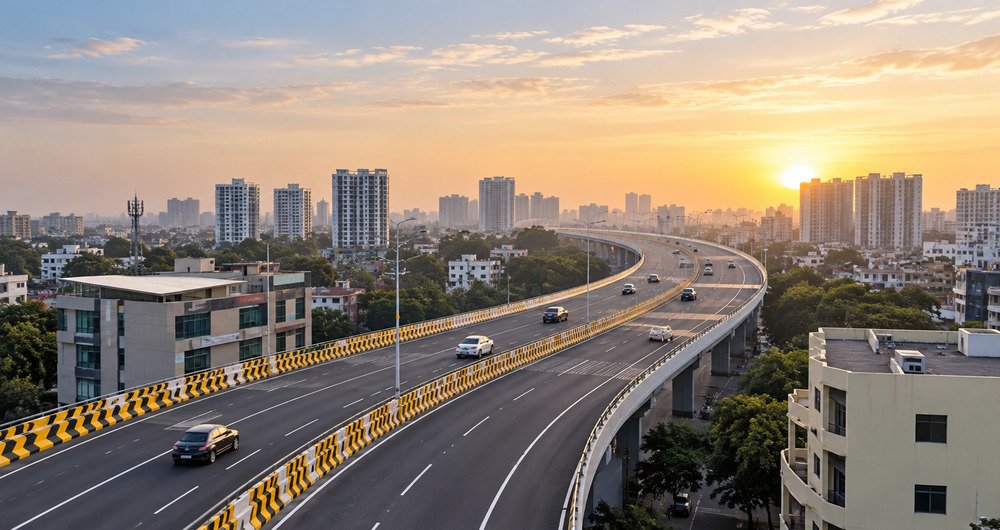
Hyderabad is set to develop a ₹1,656 crore elevated corridor connecting Banjara Hills with Shilpa Layout in Gachibowli. The proposed 9-km project aims to reduce congestion and improve connectivity between key residential, commercial, and IT areas. As a result, the corridor could make daily travel across Hyderabad’s western areas faster and more convenient.
What Is the Hyderabad Elevated Corridor Project?
The proposed 9-km elevated corridor will connect Banjara Hills with Shilpa Layout in Gachibowli. HMDA has invited tenders for the ₹1,656 crore project and plans to develop it in two phases. In addition, the project will include multiple ramps to improve access and help commuters avoid congested stretches.
Key Highlights of Hyderabad’s Elevated Corridor
The proposed project includes several important features:
- ₹1,656 crore infrastructure project
- Approximately 9-km elevated corridor
- Two-phase development plan
- Six ramps at key locations
- Ramps near Filmnagar, NAFAC Road, ITC Kohinoor, T-Hub and Mindspace
- Direct route to bypass congestion around Jubilee Hills Checkpost and the IT Corridor
- Provision for future metro expansion
- Targeted completion within 12 months after construction begins
How Will It Benefit Hyderabad Commuters?
The elevated corridor aims to improve travel between Banjara Hills, Jubilee Hills, and Gachibowli. By creating an elevated route, the project can help commuters bypass congested stretches and reduce travel time. Furthermore, the planned ramps will provide easier access to key residential, commercial, and IT areas.
As traffic continues to increase across Hyderabad, better road connectivity can make daily journeys more efficient. The corridor could also provide commuters with an alternative route during busy hours.
Six Ramps Planned at Key Locations
The project places strong emphasis on accessibility, with six ramps planned at strategic locations. These include Filmnagar, NAFAC Road, ITC Kohinoor, T-Hub, and Mindspace.
Moreover, these ramps can improve access to the elevated road and distribute traffic across different entry and exit points. This approach could support smoother traffic movement across Hyderabad’s western corridor.
Provision for Future Metro Expansion
The project also includes provisions for future metro expansion. Therefore, the elevated corridor can support Hyderabad’s long-term transportation plans while creating opportunities for better integration between road and public transport networks.
As the city continues to expand, such provisions can help accommodate future mobility requirements. In the long run, this approach could strengthen Hyderabad’s overall transportation infrastructure.
Impact on Hyderabad’s Western Corridor
Banjara Hills, Jubilee Hills, and Gachibowli serve as major residential, commercial, and business hubs in Hyderabad. Meanwhile, the surrounding IT Corridor continues to attract businesses, employees, and new developments.
Consequently, the proposed elevated corridor could strengthen connections between these important areas. It can also offer commuters an alternative route, reduce pressure on existing roads, and improve traffic movement across the western corridor.
Hyderabad’s Move Towards Better Urban Connectivity
The ₹1,656 crore elevated corridor will connect Banjara Hills with Shilpa Layout in Gachibowli and strengthen connectivity across Hyderabad’s western areas. With strategic ramps and provisions for future metro expansion, the project could address current traffic challenges while supporting the city’s future mobility needs.
Furthermore, the corridor could reduce congestion and shorten travel times between Banjara Hills, Jubilee Hills, Gachibowli, and the IT Corridor. Overall, this project marks another important step towards improving Hyderabad’s road infrastructure and creating a more efficient urban transportation network.



Join The Discussion