
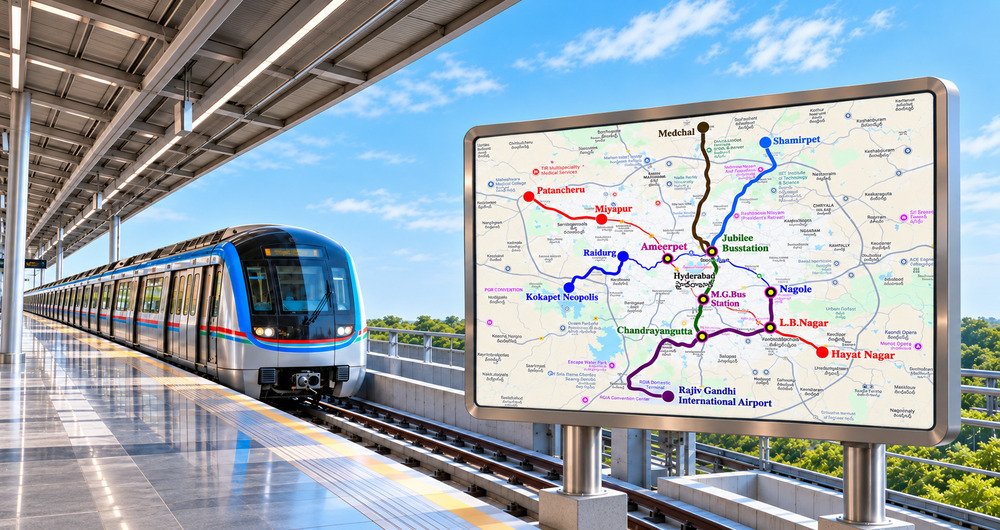
Hyderabad Metro Phase 2 has received approval from the Union Government for a proposed 76-kilometre expansion across five corridors, with an estimated project cost of ₹24,269 crore. The expansion is expected to strengthen public transport connectivity across Hyderabad and improve access to key residential neighbourhoods, IT hubs, industrial areas and the airport.
With completion targeted for 2029, the proposed Hyderabad Metro Phase 2 project represents an important step towards improving urban mobility and supporting the city’s long-term infrastructure development.
Hyderabad Metro Phase 2: Key Highlights
The proposed metro expansion aims to connect more parts of Hyderabad through an extended metro rail network.
Key highlights include:
- Project length: 76 km
- Number of approved corridors: Five
- Estimated project cost: ₹24,269 crore
- Targeted completion: 2029
- Broader Telangana proposal: 122.9 km across seven corridors, estimated at ₹38,595 crore
The wider proposal reflects Telangana’s plans to expand metro connectivity beyond the existing network and improve transportation access across the growing metropolitan region.
Hyderabad Metro Phase 2 Routes and Proposed Corridors
The broader metro expansion proposal includes seven corridors designed to improve connectivity between residential areas, commercial centres, industrial zones and other important destinations.
The proposed routes include:
- Nagole – Shamshabad Airport: Intended to strengthen metro connectivity towards Rajiv Gandhi International Airport.
- Raidurgam – Kokapet Neopolis: Planned to improve connectivity to emerging commercial and IT development areas.
- MGBS – Chandrayangutta: Expected to enhance public transport access across important parts of southern Hyderabad.
- Miyapur – Patancheru: Proposed to improve connectivity towards western Hyderabad and surrounding industrial and residential areas.
- LB Nagar – Hayathnagar: Intended to strengthen connectivity in the eastern part of the city.
- JBS – Medchal: Proposed to improve access towards northern Hyderabad and its suburban areas.
- JBS – Shamirpet: Expected to support connectivity towards northern suburban destinations.
These routes form part of Telangana’s broader proposal. The seven proposed corridors should not be confused with the five corridors covered by the reported 76-km approval.
How Hyderabad Metro Phase 2 Could Improve Connectivity
Hyderabad continues to expand as a major centre for information technology, business, education, healthcare and manufacturing. As residential communities and commercial developments spread towards the city’s outskirts, demand for reliable public transportation continues to grow.
The Hyderabad Metro Phase 2 expansion is expected to help address these mobility requirements in several ways.
1. Better Connectivity to IT and Business Hubs
Improved metro access to commercial and IT corridors could make daily commuting easier for employees and business professionals. Better connectivity may also support access to emerging commercial destinations such as Kokapet Neopolis.
2. Improved Airport Connectivity
The proposed Nagole-Shamshabad Airport corridor could improve access to Rajiv Gandhi International Airport and provide an additional public transport option for airport passengers and employees, subject to the final implementation plan.
3. Easier Travel for Residential Neighbourhoods
The proposed extensions towards Patancheru, Hayathnagar, Medchal and Shamirpet could improve public transport access for residents in developing suburban areas. Better connectivity may also make these locations more accessible for people travelling to central Hyderabad.
4. Reduced Dependence on Road Transport
Expanding metro services could encourage more commuters to use public transportation instead of private vehicles. This may help reduce pressure on busy roads, although the actual impact will depend on ridership, service frequency, last-mile connectivity and the integration of other transport systems.
Hyderabad Metro Expansion and Real Estate Development
Metro connectivity is an important consideration for homebuyers, tenants, businesses and property developers. Improved access to employment centres, educational institutions, healthcare facilities and commercial districts can influence the attractiveness of residential and commercial locations.
Areas near proposed metro corridors may receive increased attention from real estate investors and homebuyers as the project progresses. Locations such as Kokapet Neopolis, Patancheru, Hayathnagar and parts of northern Hyderabad could benefit from improved accessibility if the proposed corridors are implemented.
However, a proposed metro corridor does not guarantee property price appreciation. Actual real estate performance will depend on factors such as project execution, station locations, existing infrastructure, property demand and overall market conditions.
For buyers and investors, it is important to monitor official route alignments, station plans and construction timelines before making property-related decisions.
Hyderabad Metro Phase 2: Supporting the City’s Future Growth
The proposed 76-km expansion is part of a wider effort to improve Hyderabad’s transportation infrastructure as the city continues to grow. By extending public transport access towards emerging residential, commercial and suburban areas, the project could support more efficient commuting and better connections between different parts of the metropolitan region.
The broader seven-corridor proposal also highlights the potential for further expansion beyond the initially approved network. The final benefits will depend on project implementation, coordination between transport agencies and integration with existing metro and road networks.




Join The Discussion